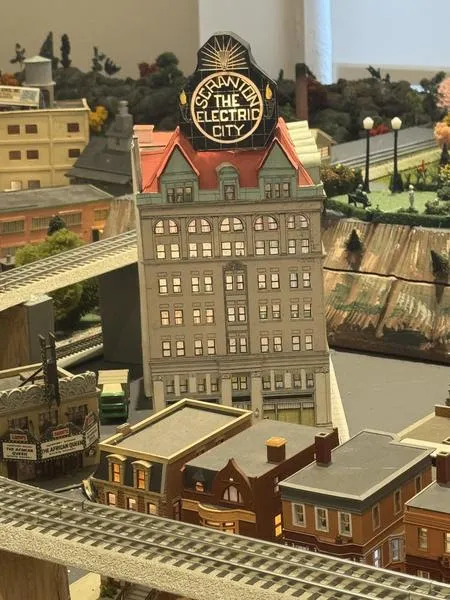
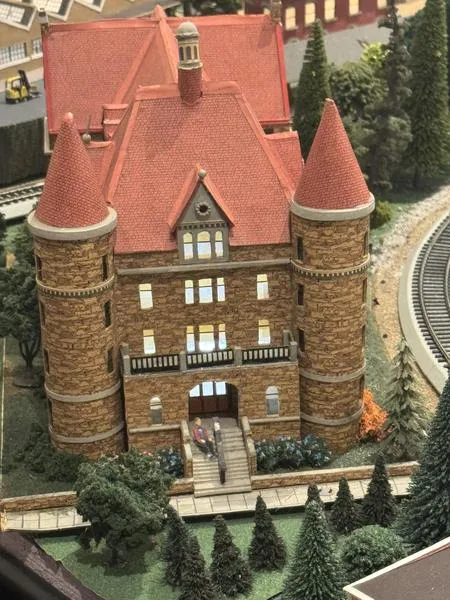
Over the holidays, I visited the Everhart Museum in Scranton, Pennsylvania. One of their current exhibits Scranton to Scale: Don Clark’s Miniatures quietly recalibrates how we think about monumentality. Clark’s meticulously crafted miniatures of Scranton landmarks aren’t nostalgic novelties—they’re acts of preservation, memory, and civic devotion rendered at an intimate scale. Although I did not grow up in Scranton, nor have I lived there, I enjoy recognizing the various icons like the Electric City Lights on Linden Street by the Courthouse, and Andrew Brown’s Pharmacy, a third generation family-owned pharmacy on the Southside of the City.
What makes these works compelling is not just their technical precision, though that alone is remarkable. It’s the way scale functions as an emotional device. Shrinking the city forces us to slow down, to notice architectural details and urban rhythms we often pass by without regard. In miniature, Scranton becomes tender—handled with care, reverence, and deep familiarity.
Clark’s practice sits at the intersection of folk art, architectural documentation, and personal archive. There’s an honesty here that resists spectacle. These objects don’t shout; they invite. You lean in. You recognize a corner, a façade, a building that once mattered—or still does.
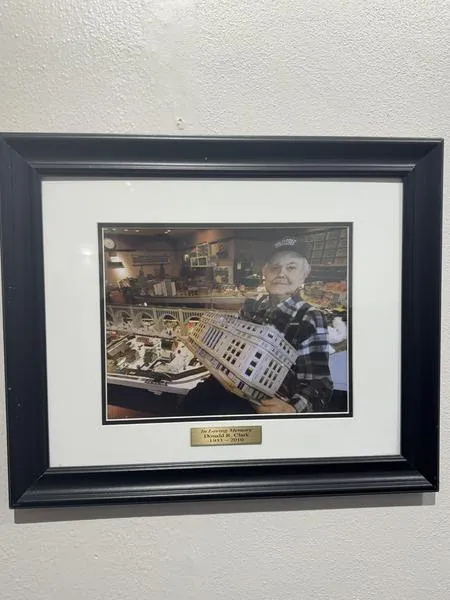
In an era when museums often chase scale upward and outward, Scranton to Scale reminds us that meaning doesn’t require grandeur. Sometimes, the most powerful way to honor a place is to hold it in the palm of your hand. However, we were not allowed to touch the models or the trains! Below is a photo of Don Clark holding one of his creations. After studying personal property appraisals at the Appraisers Association of America, and serving on the Board of Stamford History Center, I have developed a newfound appreciation of collectibles and models.