I Never Liked Video Art—Until Now
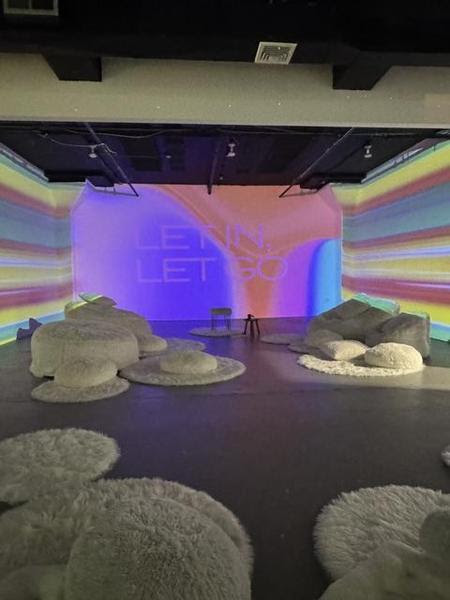
Let In, Let Go by Holly Danger at Danger Gallery
On Sunday, I attended Let In, Let Go, an intimate one-hour retreat at Danger Gallery located at 652 Glenbrook Road in Stamford. The experience was a condensed version of the gallery’s half-day retreat and offered an immersive introduction to the work of video artist and Danger Gallery founder Holly Danger.
Holly transforms ordinary spaces into immersive environments through motion, light, video, and sound, creating experiences designed to encourage connection, reflection, and a heightened awareness of our surroundings.
Approaching its 10th anniversary, Danger Gallery occupies a warehouse space that also serves as Holly’s working studio. Much of the imagery in her installations begins with footage Holly captures herself—water, flowers, industrial landscapes, and other details drawn from the world around her. She then digitally edits and layers the footage, transforming familiar imagery into enveloping visual experiences. The work is also a collaboration. Holly’s husband, Jeff, creates the binaural-beat soundscapes that accompany the installations and contributes some of the video footage.
Let In, Let Go is also the title of Holly’s exhibition, which began at the Bruce Museum in Greenwich, Connecticut, before traveling to Miami and later Korea. Experiencing the work inside Danger Gallery offered something different: the opportunity to encounter Holly’s immersive practice within the very space where much of it is created.
Curator and critic’s confession: I have a confession: I was never much of a fan of video installation art. Too often, particularly at mega-galleries and international art fairs like Art Basel, I felt the experience was less about the artwork itself and more about being part of the “art scene.” I also questioned what these immersive installations offered viewers beyond the spectacle—and, more importantly, how they could benefit or connect a community.
My experience at Let In, Let Go challenged those assumptions.
After the retreat, I left feeling rested, inspired, and, unexpectedly, connected to the other participants. Holly’s video installations do something I had previously underestimated: they bring people together. As a facilitator, Holly creates a warm, supportive environment where participants feel comfortable reflecting, sharing, and connecting with one another.
For me, the experience became a powerful example of something we often say about art but don’t always have the opportunity to experience so directly: art can truly be healing.
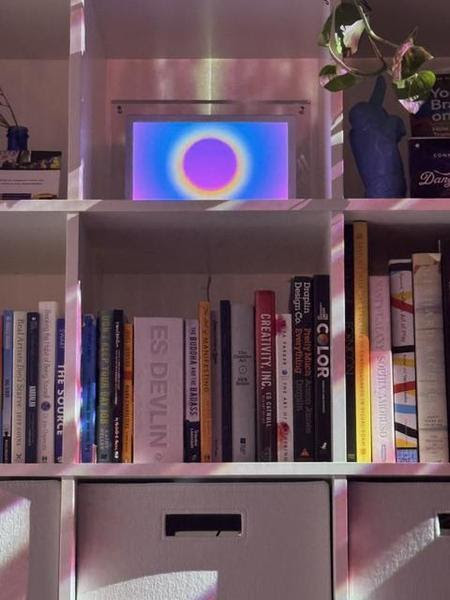
There is also an interesting collecting component to Holly’s work. Collectors can bring these moving installations into their own homes, with the work available for display on screens in two sizes. The smaller format can even be incorporated into a bookcase, making video art surprisingly accessible for collectors who may not have a large amount of wall space.
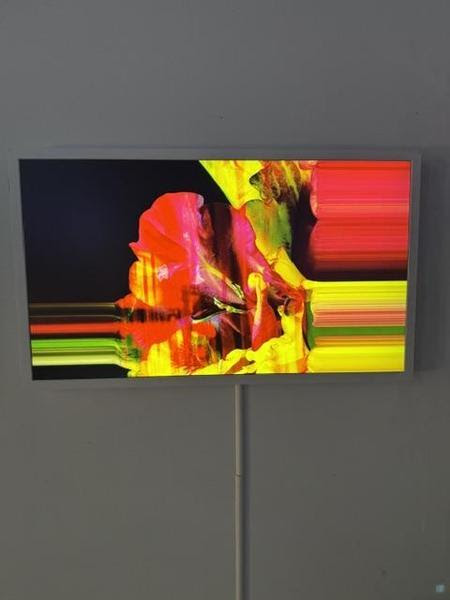
And this is one instance when a still photograph simply cannot tell the whole story. Holly’s work unfolds through movement and transition—the shifting imagery, light, and sound are integral to experiencing the beauty of the piece. You really have to see the work in motion to understand it.
I arrived at Danger Gallery skeptical of video installation art. I left looking forward to the next retreat. Changing your mind about art can be one of the pleasures of collecting it.